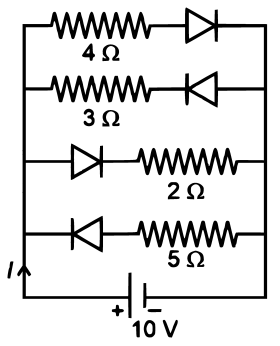
Concept:An ideal diode behaves as a closed switch when forward biased and as an open switch when reverse biased.
A diode conducts only if its anode is at a higher potential than its cathode.
Formula:Ohm's law:
I=RVParallel resistors:
Req=R1+R2R1R2Solution:The
+ terminal of the
10 V battery is on the left, so the left rail is at higher potential.
Branch with
4 Ω: diode points right, anode on positive left rail, so it is forward biased and conducts.
Branch with
3 Ω: diode points left, cathode on positive left rail, so it is reverse biased and carries no current.
Branch with
2 Ω: diode points right, anode on positive left rail, so it is forward biased and conducts.
Branch with
5 Ω: diode points left, cathode on positive left rail, so it is reverse biased and carries no current.
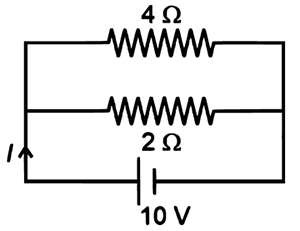
So only the
4 Ω and
2 Ω branches are active, connected in parallel across
10 V.
I4Ω=410=25 AI2Ω=210=5 AI=25+5=215 AShortcut:Req=4+24×2=34 ΩI=ReqV=4/310=215 AAnswer:I=215 A, so the correct option is D.