Concept:A diode behaves as a closed switch when forward biased and as an open switch when reverse biased.
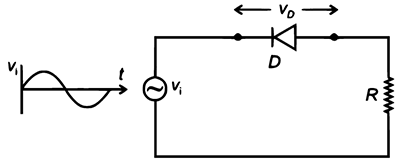
Circuit:The source
vi, the diode
D and the resistor
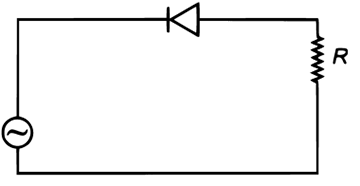
R form a single series loop, so the same current flows through all of them.
The diode is connected with its anode towards the source, so it conducts when
vi>0 and blocks when
vi<0.
Step 1 (positive half-cycle, vi>0):The diode is forward biased and conducts, so for an ideal diode the voltage across it is
vD≈0.
The full input then appears across
R.
Step 2 (negative half-cycle, vi<0):The diode is reverse biased and blocks the current.
With no current, the drop across
R is zero, so the entire source voltage appears across the diode,
vD=vi, which is negative.
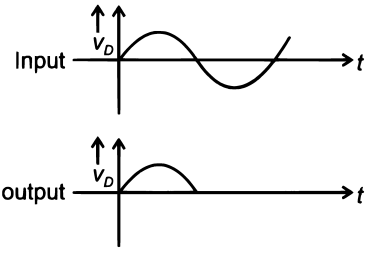
Step 3 (resulting waveform):The voltage across
D is zero throughout the positive half-cycle and follows the full sinusoidal swing of
vi (a negative hump) throughout the negative half-cycle.
Key point:The voltage across
R is the positive half-wave, while the voltage across
D is the complementary part, i.e. flat zero in the positive half and the negative half-wave in the negative half.
Answer:The correct option is the waveform that shows
vD=0 for the positive half-cycle and the full negative sinusoidal swing for the negative half-cycle.