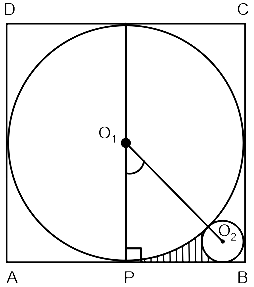
Concept:Use geometry of circles inside a rectangle to find the unknown radius, then sum their areas.
Explanation:Let the bigger circle have radius
R=4 cm (it touches the top and bottom of the rectangle of height
8 cm).
Let the smaller circle have radius
r cm.
Both circles touch each other externally, so the distance between centers
O1O2=4+r.
In the right triangle
O1EO2:
• Vertical leg
O1E=4−r (difference in distances from the top).
• Horizontal leg
EO2=5−r (since the big circle’s center is
4 cm from the left wall, the small circle’s center is
r cm from the right wall, and the rectangle width is
9 cm; gap =
9−4−r).
Apply Pythagoras:
(4+r)2=(4−r)2+(5−r)2.
Expand:
16+8r+r2=(16−8r+r2)+(25−10r+r2).
Simplify:
16+8r+r2=41−18r+2r2.
Rearrange:
0=41−18r+2r2−16−8r−r2 →
0=25−26r+r2 →
r2−26r+25=0.
Factor:
(r−1)(r−25)=0 →
r=1 or
r=25 (reject
25 as too large).
Thus
r=1 cm.
Area of bigger circle:
πR2=π×16=16π sq cm.
Area of smaller circle:
πr2=π×1=π sq cm.
Sum of areas:
16π+π=17π sq cm.
Answer:17π square unit (Option A).