Test Index
JEE Advanced 2017 Paper 1
Show Para
Paragraph for Next 3 Questions The wave function,is a mathematical function whose value depends upon spherical polar coordinates () of the electron and characterized by the quantum numbersand. Hereis distance from nucleus,is colatitude andis azimuth. In the mathematical functions given in the Table,is atomic number andis Bohr radius.
| Column 1 | Column 2 | Column 3 |
|---|---|---|
| (I) 1s orbital | (i) | 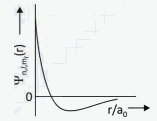 |
| (II) 2s orbital | (ii) One radial node | (Q) Probability density at nucleus |
| (III) orbital | (iii) | (R) Probability density is maximum at nucleus |
| (IV) orbital | (iv) xy-plane is a nodal plane | (S) Energy needed to excite electron from state to state is times the energy needed to excite electron from state to state |
© examsnet.com
Question : 31 of 54
Marks:
+1,
-0
Go to Question: