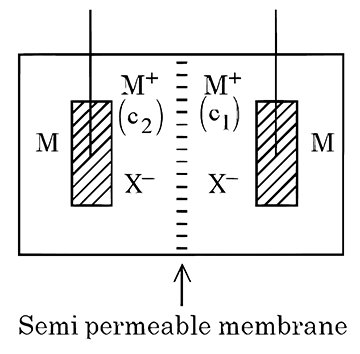
Concept:This is a concentration cell where both electrodes are made of the same metal
M, but the electrolyte concentrations (
c1 and
c2) are different. The cell potential depends on the concentration gradient.
Explanation:The cell reaction involves transfer of
M+ from higher concentration to lower concentration.
At the anode, oxidation occurs:
M→M++e−.
At the cathode, reduction occurs:
M++e−→M.
For a positive cell potential (
Ecell>0), the spontaneous direction is from higher to lower concentration.
If
c1 is at the anode, the reaction is
M+(c2)→M+(c1).
Using the Nernst equation:
Ecell=−0.059logc2c1For
Ecell>0,
c2c1<1⇒c1<c2.
If
c1 is at the cathode, the reaction is
M+(c1)→M+(c2).
Then:
Ecell=−0.059logc1c2>0This requires
c1c2<1⇒c2<c1, i.e.,
c1>c2.
Thus, a positive cell potential is obtained when
c1 is at the cathode and
c1>c2.
Answer:Option B: If
c1 is present at cathode, then
c1>c2.