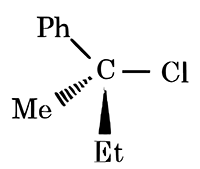
Concept:Statement I involves the effect of resonance on bond strength in vinyl halides. Statement II involves the retention of optical activity after hydrolysis of a chiral alkyl halide.
Explanation:In
CH2=CH−Cl, the lone pair on chlorine undergoes resonance with the carbon-carbon double bond. This gives the
C−Cl bond partial double bond character, making it stronger than the pure single
C−Cl bond in
CH3−CH2−Cl. Therefore Statement I is true.
The given optically active molecule is a chiral alkyl halide (for example, 2-chlorobutane). Upon hydrolysis, the reaction typically proceeds via an
SN1 mechanism due to the formation of a carbocation intermediate. The nucleophile (
OH−) can attack from either side of the planar carbocation, leading to racemization. The resulting product is a racemic mixture, which is optically inactive and does not rotate plane polarized light. Hence Statement II is false.
Answer:Statement I is true but Statement II is false. Correct option is B.