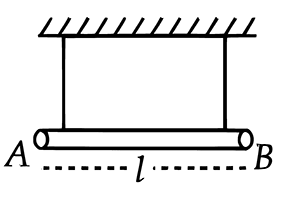
Concept:The rod undergoes both translational and rotational motion immediately after one string is cut.
Tension and weight produce linear acceleration of the centre of mass and angular acceleration about the centre of mass.
Explanation:Let
T be the tension in the remaining string and
a be the downward linear acceleration of the centre of mass.
For translational motion:
mg−T=ma …(i)
For rotational motion about the centre: torque
τ=T⋅2l​=Iα.
Moment of inertia of rod about centre is
I=121​ml2.
Thus
T⋅2l​=121​ml2α …(ii)
Kinematic relation: The end where string is still attached acts as instantaneous pivot. Hence
a=α⋅2l​, so
α=l2a​.
Substitute
α in (ii):
T⋅2l​=121​ml2⋅l2a​⇒T=3ma​ …(iii)
From (i) and (iii):
mg−3ma​=ma⇒mg=34​ma⇒a=43g​.
Then
T=3m​⋅43g​=4mg​.
Alternatively, from (i) and (iii):
mg−T=3T⇒mg=4T⇒T=4mg​.
Answer:The tension is
4mg​.
Thus the correct option is
B.
4mg​.