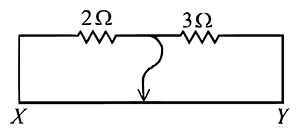
Concept:The meter bridge works on the Wheatstone bridge principle.
The balancing condition gives the ratio of resistances equal to the ratio of the corresponding lengths of the wire.
Explanation:Let
l1 be the initial balancing length from end X.
Given
R1=2 Ω and
R2=3 Ω.
Using the bridge formula:
R2R1=100−l1l1.
Substitute:
32=100−l1l1.
Cross-multiply:
2(100−l1)=3l1.
Simplify:
200−2l1=3l1⇒200=5l1, so
l1=40 cm.
Initial null point is at 40 cm from X.
An unknown resistor
X is connected in parallel with the
3 Ω resistor in the right gap.
New effective right gap resistance:
R2′=3+X3X.
The null point shifts 22.5 cm toward Y, so new length
l2=l1+22.5=62.5 cm.
Apply bridge condition again:
R2′R1=100−l2l2.
Substitute:
R2′2=37.562.5=35.
Hence
R2′=2×53=56=1.2 Ω.
Now
1.2=3+X3X. Multiply:
1.2(3+X)=3X⇒3.6+1.2X=3X.
So
3.6=1.8X, thus
X=1.83.6=2 Ω.
Answer:The unknown resistance is
2 Ω, which corresponds to option D.