Concept:The equivalent resistance between two points in a network is found by identifying parallel paths and calculating the combined resistance using the reciprocal formula.
Explanation:The wire has resistance per unit length
λ Ω/m.
Resistance
R=λ×length.
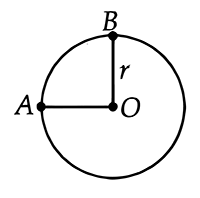
Three paths exist between A and B, all in parallel.
Path 1 (minor arc AB) – a quarter of the circle: length
=41×2πr=2πr.
R1=λ(2πr).
Path 2 (major arc AOB) – three-quarters of the circle: length
=43×2πr=23πr.
R2=λ(23πr).
Path 3 (straight wire AOB): given total length
=2r (AO + OB =
r+r).
R3=λ(2r).
These three resistances are in parallel, so
Req1=R11+R21+R31.
Req1=λπr2+3λπr2+2λr1.
Req1=λr1(π2+3π2+21).
Req1=λr1(6π12+4+3π)=6πλr16+3π.
Req=16+3π6πλr.
Answer:The equivalent resistance is
3π+166πλr Ω, which corresponds to option (B).