Concept:The capacitance of a parallel plate capacitor depends on the area of plates, separation, and the dielectric constant.
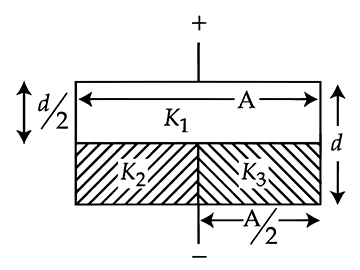
This arrangement is broken into individual capacitors and then combined using series and parallel rules.
Explanation:Let the original capacitance without dielectric be
C=dϵ0A.
The gap
d is divided into two halves, each of thickness
2d.
For the top half: dielectric
K1=2 covers the full area
A.
Its capacitance is
C1=d/2K1ϵ0A=d/22ϵ0A=4C.
For the bottom half: two dielectrics
K2=3 and
K3=5 each cover area
2A and thickness
2d.
C2=d/23ϵ0(A/2)=3C.
C3=d/25ϵ0(A/2)=5C.
Since
C2 and
C3 share the same potential difference, they are in parallel:
C23=C2+C3=8C.
Now
C1 (top half) and
C23 (bottom half) are in series because the charge flows through one then the other.
The equivalent capacitance:
Ceq1=C11+C231=4C1+8C1=8C3.
Thus
Ceq=38C.
Given
Ceq=3nC, we get
38C=3nC, so
n=8.
Answer:n=8, which corresponds to option A.