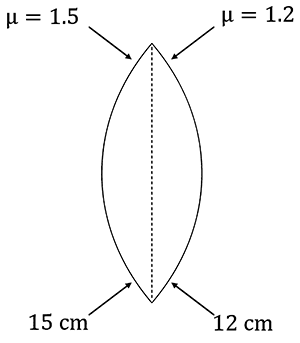
Concept:A biconvex lens can be considered as two thin planoconvex lenses in contact. Their combined focal length is found by adding their powers.
Explanation:For left planoconvex lens
L1: refractive index
μ1=1.5, curved surface radius
R1=+15 cm (convex towards left), plane surface
R2=∞.
Using Lens Maker’s formula:
f11=(μ1−1)(R11−R21)=(0.5)(151−∞1)=150.5=301.
Thus
f1=+30 cm.
For right planoconvex lens
L2: refractive index
μ2=1.2, plane surface
R1=∞, curved surface radius
R2=−12 cm (convex towards right, so sign negative as per sign convention).
Using Lens Maker’s formula:
f21=(1.2−1)(∞1−−121)=(0.2)(0+121)=120.2=601.
Thus
f2=+60 cm.
Since the lenses are thin and in contact, the combined focal length
F is given by
F1=f11+f21.
F1=301+601=602+1=603=201.
So
F=+20 cm.
Object distance
u=−30 cm (sign convention).
Lens formula:
v1−u1=F1.
v1−−301=201v1+301=201v1=201−301=603−2=601Therefore
v=+60 cm.
Magnification
m=uv=−3060=−2.
The negative sign means the image is real and inverted, and twice the size of the object.
Answer:A.
−2