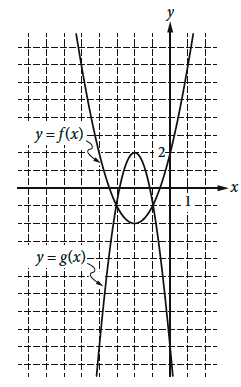
For any value of x, say
x=x0,
the point
(x0,f(x0)) lies on the graph of f and the point
(x0,g(x0)) lies on the graph of g.
Thus, for any values of any value of x, say
x=x0,
the value of
f(x0)+g(x0) is equal to the sum of the y-coordinates of the points on the graphs of f and g with x-coordinate equal to
x0.
Therefore, the value of x for which f(x) + g(x) is equal to 0 will occur,
when the y-coordinates of the points representing
f(x) and
g(x) at the same value of x are equidistant from the
x−axis and are on opposite sides of the x-axis.
Looking at the graphs, one can see that this occurs at
x=−2: the point
(−2,−2) lies on the graph of f, and the point
(−2,2) lies on the graph of
g.
Thus, at
x=−2, the value of
f(x)+g(x) is
−2+2=0.
Choices A, C, and D are incorrect because none of these x-values satisfy the given equation,
f(x)+g(x)=0.