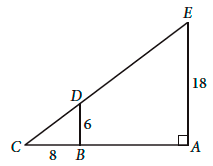
In the figure given, since
BD− is parallel to
AE− and both segments are intersected by
CE− , then angle BDC and angle AEC are corresponding angles and therefore congruent. Angle BCD and angle ACE are also congruent because they are the same angle. Triangle BCD and triangle ACE are similar because if two angles of one triangle are congruent to two angles of another triangle, the triangles are similar. Since triangle BCD and triangle ACE are similar, their corresponding sides are proportional. So in triangle BCD and triangle ACE,
BD− corresponds to
AE− and
CD− corresponds to
CE−. Therefore,
CDBD​=CEAE​ Since triangle BCD is a right triangle, the Pythagorean theorem can be used to give the value of CD
62+82=CD2 Taking the square root of each side gives CD = 10. Substituting the values in the proportion
CDBD​=CEAE​ yields
106​=CE18​ Multiplying each side by CE, and then multiplying by
610​ yields CE = 30. Therefore, the length of
CE− is 30.