Test Index
SAT Reading Practice Test 6
Show Para
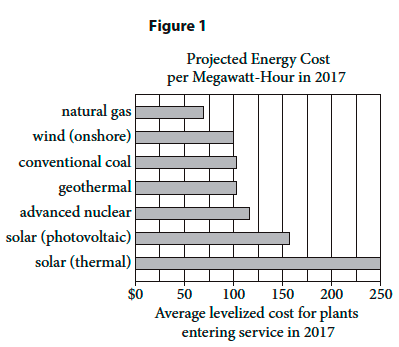
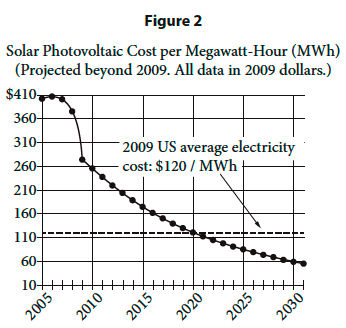
Questions 43-52 are based on the following passage and supplementary material.
This passage is adapted from Kevin Bullis, “What Tech Is Next for the Solar Industry?” ©2013 by MIT Technology Review. Solar panel installations continue to grow quickly, but the solar panel manufacturing industry is in the doldrums because supply far exceeds demand. The poor market may be slowing innovation, but 5 advances continue; judging by the mood this week at the IEEE Photovoltaics Specialists Conference in Tampa, Florida, people in the industry remain optimistic about its long-term prospects. The technology that’s surprised almost everyone 10 is conventional crystalline silicon. A few years ago, silicon solar panels cost 4 per watt, and \newline Martin Green, professor at the University of \newline New South Wales and one of the leading silicon solar \newline panel researchers, declared that they'd never go \newline 15 below 1 a watt. ``Now it's down to something like \newline 50 cents a watt, and there's talk of hitting 36 cents per \newline watt,'' he says. \newline The U.S. Department of Energy has set a goal of \newline reaching less than 1 a watt—not just for the solar 20 panels, but for complete, installed systems—by 2020. Green thinks the solar industry will hit that target even sooner than that. If so, that would bring the direct cost of solar power to six cents per kilowatt-hour, which is cheaper than the average cost 25 expected for power from new natural gas power plants. All parts of the silicon solar panel industry have been looking for ways to cut costs and improve the power output of solar panels, and that’s led to steady 30 cost reductions. Green points to something as mundane as the pastes used to screen-print some of the features on solar panels. Green’s lab built a solar cell in the 1990s that set a record efficiency for silicon solar cells—a record that stands to this day. To 35 achieve that record, he had to use expensive lithography techniques to make fine wires for collecting current from the solar cell. But gradual improvements have made it possible to use screen printing to produce ever-finer lines. Recent research 40 suggests that screen-printing techniques can produce lines as thin as 30 micrometers—about the width of the lines Green used for his record solar cells, but at costs far lower than his lithography techniques. Meanwhile, researchers at the National Renewable 45 Energy Laboratory have made flexible solar cells on a new type of glass from Corning called Willow Glass, which is thin and can be rolled up. The type of solar cell they made is the only current challenger to silicon in terms of large-scale production—thin-film 50 cadmium telluride. Flexible solar cells could lower the cost of installing solar cells, making solar power cheaper. One of Green’s former students and colleagues, Jianhua Zhao, cofounder of solar panel manufacturer 55 China Sunergy, announced this week that he is building a pilot manufacturing line for a two-sided solar cell that can absorb light from both the front and back. The basic idea, which isn’t new, is that during some parts of the day, sunlight falls on the 60 land between rows of solar panels in a solar power plant. That light reflects onto the back of the panels and could be harvested to increase the power output. This works particularly well when the solar panels are built on sand, which is highly reflective. Where a 65 one-sided solar panel might generate 340 watts, a two-sided one might generate up to 400 watts. He expects the panels to generate 10 to 20 percent more electricity over the course of a year. Even longer-term, Green is betting on silicon, 70 aiming to take advantage of the huge reductions in cost already seen with the technology. He hopes to greatly increase the efficiency of silicon solar panels by combining silicon with one or two other semiconductors, each selected to efficiently convert a 75 part of the solar spectrum that silicon doesn’t convert efficiently. Adding one semiconductor could boost efficiencies from the 20 to 25 percent range to around 40 percent. Adding another could make efficiencies as high as 50 percent feasible, which 80 would cut in half the number of solar panels needed for a given installation. The challenge is to produce good connections between these semiconductors, something made challenging by the arrangement of silicon atoms in crystalline silicon. © examsnet.com
Question : 46 of 52
Marks:
+1,
-0
Go to Question: