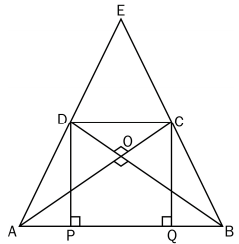
Let the distance between the parallel sides be h cm.
ΔABE is an equilateral triangle.
∠A = ∠B = ∠E = 60°
Also, ∠EDC = ∠A=60° and ∠ECD = ∠B=60° (Corresponding pair of angles)
Therefore,ΔEDC is an equilateral triangle
AE = BE
DE = CE
∴ AE- DE = BE - CE
⇒AD = BC ...(1)
Therefore, trapezium ABCD is an isosceles trapezium.
⇒BD = AC (Diagonals of isosceles trapezium are equal)
Now ΔAPD ≅ ΔBQC (RHS congruence rule)
∴ AP = BQ = b(say)
Let CD = PQ = a
Area of trapezium
=21​×AC×OD+21​×AC×OB=21​×AC×BD=21​BD2Using (1)
∴21​BD2=16⇒BD2=32Area of trapezium
∴(a+b)×h=16⇒a+b=h16​In right ΔBPD,
h2+(a+b)2=BD2⇒h2+(h16​)2=32Using option:
⇒h=4cm